The Meaning of the Knight in Chess
The knight is the chess piece that refuses to follow a straight path. It jumps, changes direction and teaches beginners that a good plan can be indirect, creative and surprising.
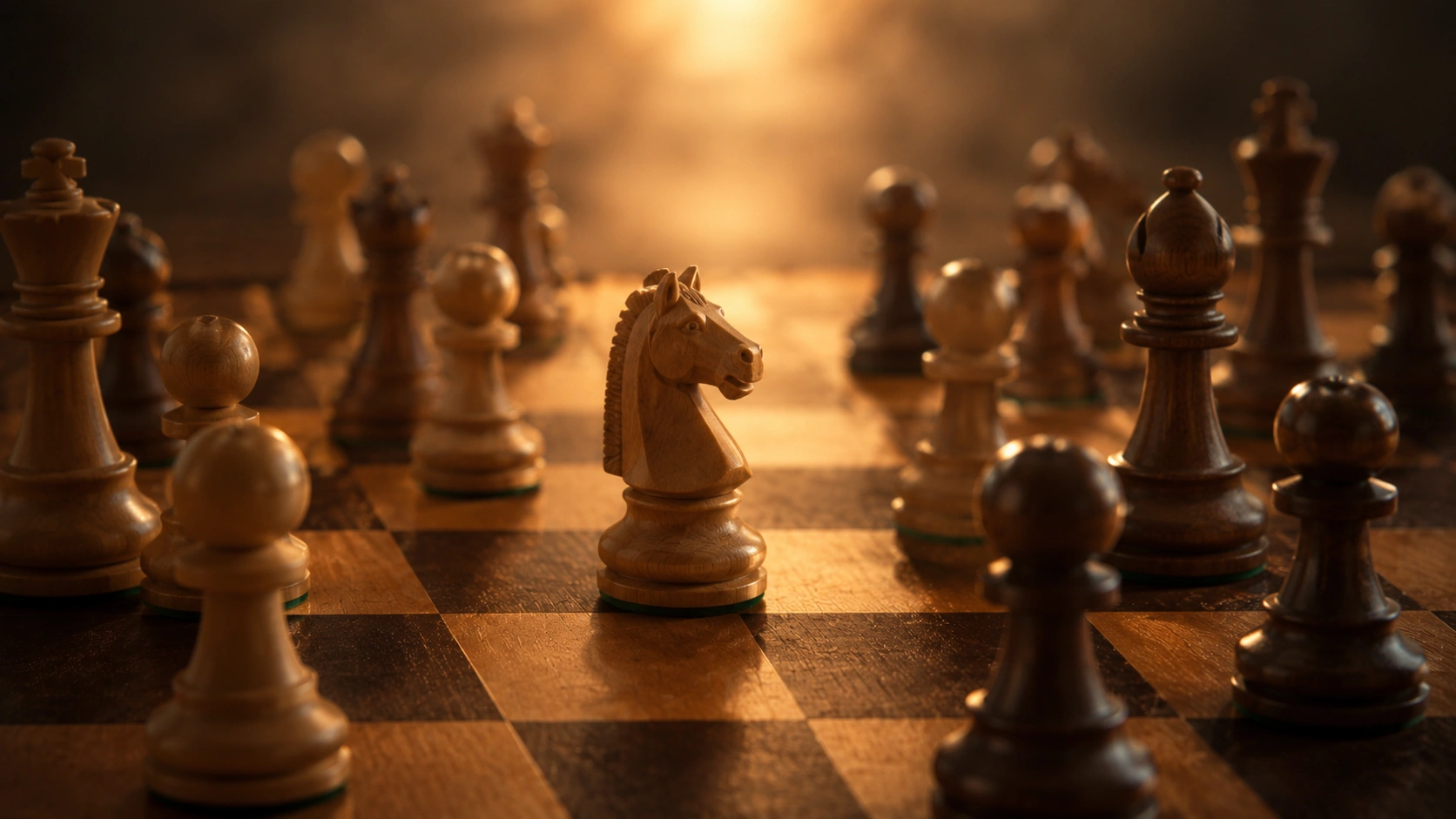 The Meaning of the Knight in Chess
 The knight is the chess piece that refuses to follow a straight path. It jumps, changes direction and teaches beginners that a good plan can be indirect, creative and surprising.
A piece that does not choose the straight path
The knight is one of the most characteristic pieces in chess. It does not move in straight lines like a rook, diagonally like a bishop or with the broad freedom of a queen. Its strength comes from a different idea: the knight can reach places that other pieces cannot reach directly.
That is why the meaning of the knight in chess is not limited to the rule of movement. The knight teaches creativity, patient manoeuvring and the search for solutions that are not obvious at first sight.
The main lesson of the knight is simple: in chess, not every good path is a straight path.
Why is the knight a unique piece?
The knight is unique because it works differently from every other chess piece. It jumps over pieces and moves in an L-shape, so a beginner has to learn to see the board in a new way.
The knight does not show its power through a long line. Its meaning comes from flexibility, surprise and the ability to appear on squares that are easy to overlook.
This makes the knight difficult to evaluate. Sometimes it looks quiet, but it may control important squares, defend key points or suddenly create a threat. For this reason, the knight should be understood not only as a piece with movement rules, but also as a symbol of a different kind of chess thinking.
The meaning of the knight in the game
In real games, the knight often becomes important when the position is closed or full of obstacles. Line pieces need open files, ranks or diagonals. A knight can still act when the board is crowded.
For a beginner, the knight is a reminder that the strength of a piece depends on context. The same knight can be weak on the edge of the board and strong near the centre. It may look calm, but at the same time control squares that decide the next plan.
The knight also shows that chess is not only about what is happening now. You need to see future squares, hidden possibilities and quiet pressure. A well-placed knight can change the character of a position even before it makes a direct attack.
The knight as a symbol of creativity
Symbolically, the knight can stand for creativity. It does not choose the most obvious road and it does not act as predictably as pieces that move along lines. It shows that the best solution may require a different angle.
This is very important in chess learning. A beginner often searches only for direct moves: a direct attack, a direct defence or a simple exchange. The knight encourages a better question: is there another square, another route or another way to solve the problem?
That is why the knight fits the idea of creative thinking. It is not about random moves. It is about finding a path that was not visible at the start.
The knight and indirect solutions
The knight reminds us that direct force does not always decide the position. Sometimes the result depends on placement, rhythm, patience and timing. A well-placed knight can create more practical problems than a piece with a longer range.
This feature is especially useful for learners. The knight shows that you should look for squares, not only captures. You should understand tension on the board, not only count material. A piece can become dangerous before it attacks directly.
In this sense, the knight asks different questions: which square will matter, where can I create pressure, and how can I get around an obstacle that cannot be solved by a straight move?
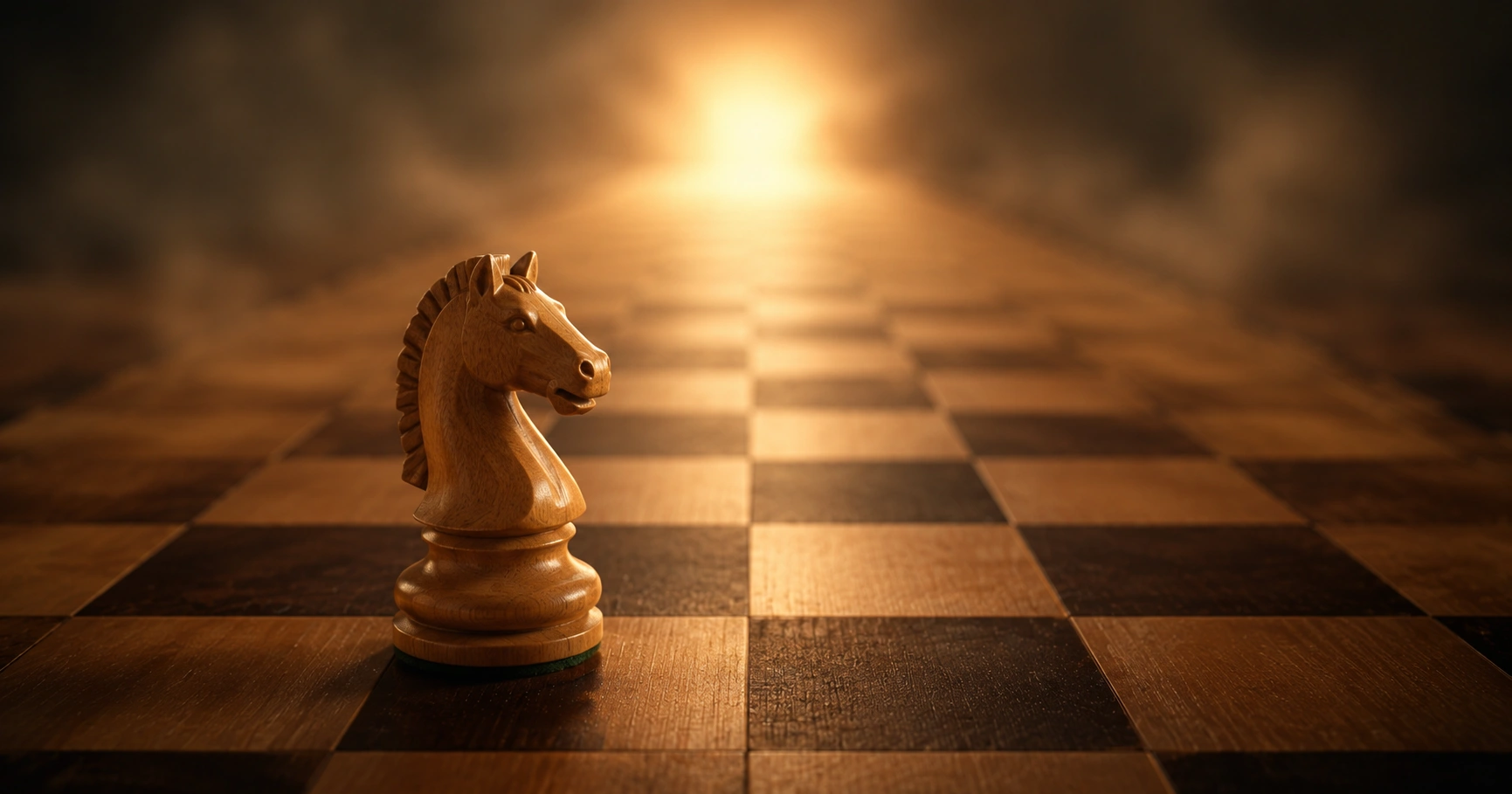
The knight’s indirect path
What does the knight teach a beginner?
The knight teaches patience and imagination. It does not always act immediately. It often needs a good square, preparation and a clear understanding of the position.
For a beginner, the most important lesson is simple: look at squares, not only at pieces. A knight can control key places, block an opponent’s plan and create threats that are not easy to see at first sight.
This piece also helps beginners understand that chess is not only a fast attack. Sometimes the best plan is to improve a piece slowly, find a better square and prepare an idea that becomes important several moves later.
A common mistake when understanding the knight
A common mistake is judging the knight only by whether it attacks something immediately. A knight can be very important even when it is not capturing a piece. Its value often comes from the squares it controls, its presence near the centre and its future threats.
Another mistake is leaving the knight on the edge of the board without a plan. Such a knight usually has fewer options. Understanding the meaning of the knight helps a learner see why this piece needs the right square to show its real strength.
So the point is not only to know how the knight moves. It is more important to understand why the knight goes to a certain square and what role it can play in the whole plan.
Connection with the Chesswood Edu knight lesson
This article explains the meaning, role and symbolism of the knight. If you first want to learn the basic rules of the piece, go to the Chesswood Edu knight lesson.
There you can learn how the knight moves, why its L-shape is special and what beginners should notice during their first games.
Connection with Chesswood Edu knight tactics
When you understand the meaning of the knight, you can move on and see how this piece works in practical tactical motifs. The knight often surprises the opponent because its threats are not always visible at once.
Knight tactics show the practical side of this piece: pressure on key squares, indirect manoeuvres and positions where the knight suddenly becomes very active.
Summary
The knight is a piece of creativity, patience and surprise. Its meaning is not only about how it moves, but also about how it changes the way a player looks at the board.
The knight shows that in chess it is worth searching not only for direct attacks, but also for important squares, hidden possibilities and plans that mature over several moves. A well-placed knight can restrict the opponent, create pressure and find a path where other pieces see only an obstacle.
The main message of the knight is simple: sometimes the best solution does not follow a straight path.

Test: the meaning of the knight in chess
Automatic testThis test checks the meaning of the knight, not only the rule of movement.
Choose the best answer in each question. The answer key is hidden until you check or open it.
A. Meaning and symbolism
The knight is more than a movement rule.
B. Planning with the knight
A knight often needs preparation and a good square.
C. Closed positions and indirect routes
The knight can act when straight paths are blocked.
D. Knight tactics
The knight can surprise because its attacks are less obvious.
Export ready
This export prepares only the current section: the test about the meaning of the knight in chess.
FAQ
Why is the knight important in chess?
The knight is important because it can jump over pieces, create forks, control unusual squares and attack in ways that are difficult to predict.
Why is the knight different from other pieces?
The knight is the only piece that can jump over other pieces. It moves in an L-shape, which makes its path indirect and often surprising.
Is the knight strong in closed positions?
Yes. Knights are often strong in closed positions because they can jump over blocked pawns and pieces.
What does the knight symbolize in chess?
The knight symbolizes creativity, flexibility, surprise and the ability to find indirect paths.
What is a knight fork?
A knight fork is a tactic where the knight attacks two or more important targets at the same time, often including the king, queen or rook.
Do you want to understand the knight better?
Start with the Chesswood Edu knight lesson, then move to knight tactics and see how this jumping piece creates surprising threats in real positions.